Clean up any spills immediately; this is especially important for acidic substances and fruit juices. Instead of wiping and spreading the liquid across the granite surface, try to blot up the liquids and acidic substances with a cloth. This reduces the risk of the stain spreading.
The issue of removing stains from stone typically arises with indoor flooring—particularly in kitchens—since the visibility of stains is less of a concern for exterior stonework. Furthermore, when discussing stone staining, the focus is usually on marble and, subsequently, crystalline (or “Chinese”) stone; this is because granite generally has very low water absorption and is rarely used for interior flooring.
Why does stone get stained?
Due to their physical structure and composition, marble stones are highly susceptible to damage from acidic substances and scratching. Spilling acidic liquids—such as lemon juice, sour grape juice, citrus juices (orange, sweet lime, sour orange), vinegar, milk, or *doogh* (yogurt drink)—can erode the stone’s surface and cause staining, depending on the acidity level. The remainder of this article explores various methods for removing stains from the stone.

Methods for removing stains from stone
The methods for removing stains from marble and crystalline limestone (often referred to as “Chinese stone” in Iran) are similar, given the shared characteristics that make both stone types susceptible to staining. For this reason—and because marble is far more commonly used for flooring—this article focuses specifically on marble. (It is worth noting that marble offers significantly less resistance to acidic substances, such as lemon juice, compared to crystalline limestone.)
Despite all its beauty and positive attributes, marble is susceptible to permeability and discoloration due to the following reasons:
· Texture resistant to acidic substances and oil
· Composed of materials that react to acidic conditions
· Low scratch resistance
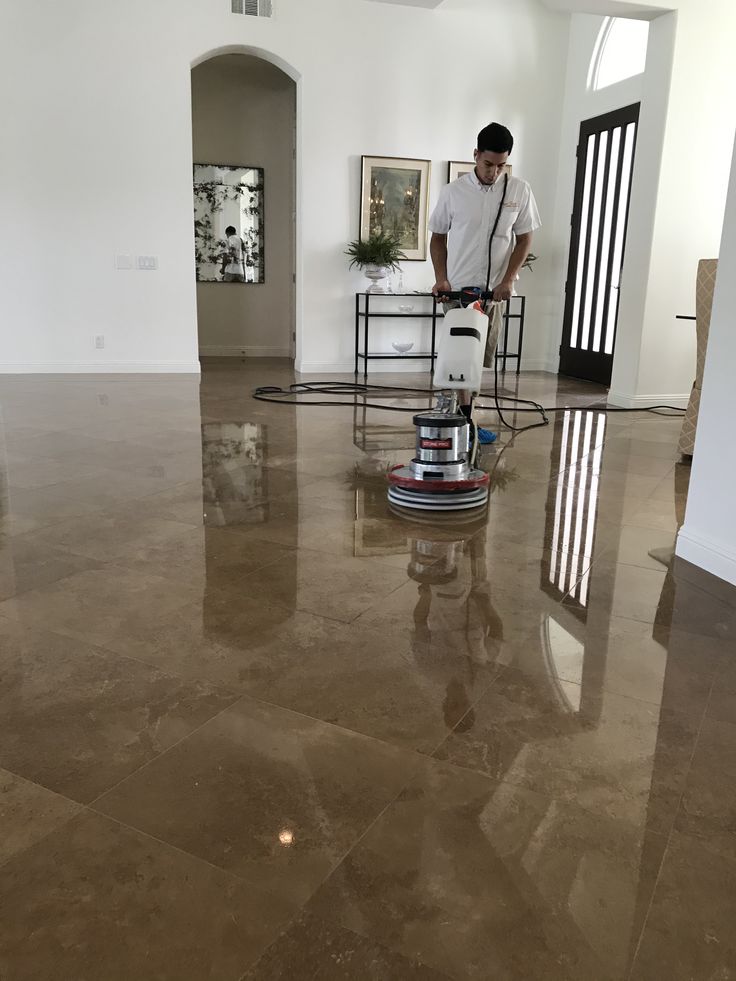
One of the most fundamental and comprehensive solutions for removing stains from stone is the use of a stone grinding and polishing machine. This process removes an extremely thin layer of the stone, revealing a fresh, clear layer beneath. However, this method requires professional technicians and entails associated costs, whereas simpler solutions may also be available depending on the specific circumstances.
In addition to surface grinding, simpler methods—such as using a baking soda paste or specialized stone cleaners—can also be effective for removing surface stains, depending, of course, on the type of stain and the nature of the stone.
Now, we will examine methods for removing stains from stone, depending on the circumstances.
1/ Removing small, localized stains from the stone
Stains on indoor and kitchen stone flooring are often small, caused by spills of acidic liquids or water. In such cases, removing the stains does not require a floor polishing machine, an angle grinder, or specialized tools; the stains can be eliminated by following the steps below in order.
- First, pour a little water onto the surface so that the stained area is completely covered.
- Then, using 1200 or 1500-grit sandpaper, sand only the stained area continuously for one minute, applying slight pressure.
- Then, gently sand the stained area for 2 to 3 minutes, moving in all directions. (As you sand, you will notice the stone surface becoming increasingly smooth and slippery; this indicates that the stone is being polished and buffed.)
- Dry the surface and allow the moisture to evaporate completely. You will observe that the stain has diminished somewhat, yet it still does not exhibit the same light reflection at a 45-degree angle as the surrounding unaffected areas.
- Now, using a clean cloth, apply the nano stone polishing and protective wax to the stone.
- After three hours, clean the stone surface with a soft steel wool pad and continue doing so until the surface is completely polished.
2/ Discoloration of the flooring stone (medium-sized)
To remove stains from medium-sized stone surfaces, you can use an angle grinder equipped with wet-sanding discs—ranging up to grit 1200—to achieve a polished finish. In this process, discs ranging from grit 60 to 600 are used depending on the extent of the surface damage, while grits 800 to 1200 are employed to produce the final shine and luster.
3/ Stone repair for large stains
تغییر رنگ و ایجاد لکه های بزرگ در سنگ کف در مقیاس های بزرگ، بدون شک برای پاک کردن لکه از روی سنگ نیاز به دستگاه ساب زنی می باشد.
Can stone be ground or polished using an angle grinder and a sanding/polishing disc?
An angle grinder is a primary tool for grinding small surface areas. This process can be performed using various types of abrasive paper (dry, without water) or abrasive blocks/segments (wet, with water). Abrasive grits range from coarse (60 and 80) to fine (1200). It is worth noting that achieving a high-quality finish with a handheld grinder requires precision to ensure the result is as glossy and uniform as a factory finish.